Life Cycle Assessment
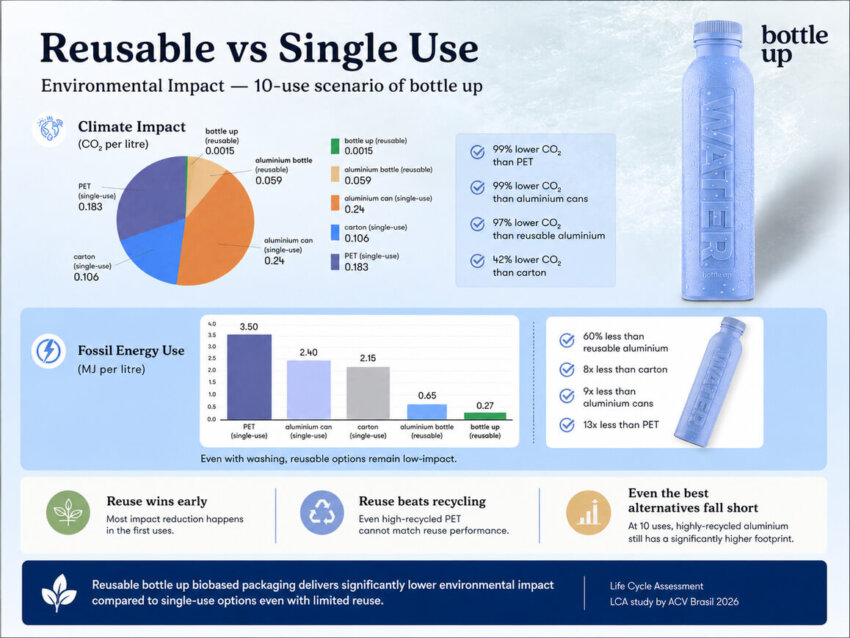
To better understand the environmental impact of different water packaging options, we commissioned an independent Life Cycle Assessment (LCA) comparing bottle up with some of the most commonly used alternatives, including PET bottles, aluminium cans, cartons and reusable aluminium bottles. What makes the study particularly interesting is that it allows these different packaging formats to be compared within the same assessment. It looks beyond the material alone and considers the full life cycle of each packaging format, from production and transport to end-of-life and, where relevant, washing between uses.
More than 95% lower climate impact
The results show just how powerful the combination of reuse and material choice can be.
When used 10 times, bottle up has a more than 95% lower climate impact than all alternatives included in the comparison.
Importantly, bottle up doesn’t need to be reused dozens of times before the environmental benefits start to show. After just a few uses, its climate impact is already lower than the alternatives assessed, with the advantage increasing further with every additional use.
This is an important part of the story. Simply making a bottle reusable is not enough to achieve the lowest possible impact. The material it is made from matters too.
Bottle up combines a lightweight design with biobased PE and reuse. The relatively low impact of the material, combined with spreading that impact across multiple uses, is what makes the difference.
Reusable doesn’t automatically mean low impact
One of the most interesting findings is the comparison with a pre-filled reusable aluminium bottle. Although both formats are designed to be reused, the aluminium alternative still has a significantly higher climate impact in the 10-use scenario.
For us, this reinforces one of the main conclusions from the study: the future of water packaging isn’t just about reuse. It’s about combining reuse with the right material.
With European packaging legislation increasingly focused on reducing packaging waste, improving circularity and encouraging reuse, the results give us confidence that bottle up is well positioned for the direction in which packaging is moving.
To ensure the methodology and conclusions are robust, the LCA was also independently reviewed by a third party.
The infographic highlights some of the key findings from the study.
For more information about the LCA and its findings, please contact us at hello@bottleup.com.